Our Own Network — AS133643

Fully Managed Dedicated Servers in India

Dedicated physical servers in India with 24×7 infrastructure management

CtrlS · Iron Mountain · Yotta — Delhi NCR, Mumbai & Pune

  • Published support scope — what we manage, and what remains yours
  • Full root / Administrator access retained by you
  • 24×7 monitoring and incident response by our in-house NOC
  • AS133643 — our own ASN; customer IP announcement supported
  • Backups, restores and standard migration included in the monthly fee
  • Latest CPU AMD EPYC 9005 (Turin), AMD EPYC 9004 (Genoa), AMD EPYC 9454P, Intel Xeon 6741P
  • Suited to databases, ERP, SaaS backends and high-traffic websites
Request a Quotation     See What We Manage
2007 Hosting Since
25,000+ Customers Served
AS133643 Our Own ASN
24×7 NOC Monitoring
Published Support Scope
Migration Assistance Included
IPMI / KVM Remote Access
Data Resident in India
Restores Not Billed Separately
Support scope, server configurations and facility information last reviewed: August 2026

Managed Dedicated Server Hosting in India

A managed dedicated server gives you an entire physical server for your workload, while our technical team handles the operating system and day-to-day server administration.

Because the hardware is dedicated to one customer, CPU, RAM, storage and network resources are not shared with other virtual machines. This makes dedicated servers a good choice for applications that need consistent performance, including databases, ERP systems, SaaS applications and high-traffic websites.

With our managed service you retain full root or Administrator access. Our team takes care of server setup, security hardening, updates, monitoring, backups, troubleshooting and hardware-related issues, so your team can continue to manage your applications while we handle the underlying infrastructure.

If you already have an experienced system administration team and only need the hardware, our unmanaged dedicated servers may be a better and less expensive option.

Who should consider a managed dedicated server?

A managed dedicated server is generally suitable when:

  • Your application needs consistent CPU, memory and storage performance.
  • You operate a busy database, ERP, SaaS application or high-traffic website.
  • Your team has developers but no dedicated Linux or Windows server administrator.
  • You need technical support for operating system updates, security, backups and monitoring.
  • Business or compliance requirements mean the server should remain in India.
  • You are moving away from public cloud because the monthly cost has become difficult to predict.

When a managed dedicated server may not be the right choice

A different hosting solution may make more sense if your workload changes dramatically through the day and you need to add or remove capacity within minutes. A cloud VPS or public cloud platform is usually better suited to that pattern.

Similarly, if your company already has a server administration team and only needs dedicated hardware, an unmanaged dedicated server will reduce your monthly cost. For a small brochure website, shared or reseller hosting normally provides sufficient resources at a much lower cost.

What Does Managed Dedicated Hosting Actually Cost?

The monthly server price is only one part of the cost of running dedicated infrastructure. If you operate the server yourself, you also need to account for system administration, security updates, monitoring, backups, incident response and hardware troubleshooting.

With our managed service, these infrastructure management tasks are included in the support scope shown below.

For comparison, a company operating its own round-the-clock server administration may need more than one administrator to provide continuous coverage. The actual cost depends on the number of servers, operating systems, applications and the level of support required.

Our NOC already provides 24×7 infrastructure monitoring and incident response, so customers do not need to build a separate server administration rota for a single dedicated server.

Pricing: managed dedicated servers are quoted per configuration following a workload review, because the management effort depends on the application stack rather than the hardware. Quotations cover configuration, facility, network port, support scope and contract terms. Billing in INR or USD, GST invoiced.

What Server Management Covers

This is the responsibility matrix our support team works from. Tasks marked Included are covered by the monthly fee. The third column states what remains the customer's responsibility.

Included covered by the monthly fee Billable quoted project or hourly work Yours customer-owned, we advise only
Managed dedicated server responsibility matrix
Task Scope What eWebGuru does / what you provide
OS install, partitioning and hardeningIncludedWe build the OS, apply a CIS-informed baseline and configure LVM or ZFS. You confirm the required layout and application prerequisites.
Security patching and kernel updatesIncludedWe monitor and apply OS and security updates. You confirm application compatibility where a patch may affect your software.
Firewall, brute-force protection, SSH policyIncludedWe configure CSF/LFD or nftables and edge filtering on AS133643. You tell us which ports and sources your application needs.
Control panel install and upkeepIncludedWe install and maintain cPanel & WHM, Plesk Obsidian or DirectAdmin. The control panel licence is billed at cost.
Web server, PHP-FPM and cache configurationIncludedWe configure Apache, NGINX or LiteSpeed and size PHP pools. You specify the PHP versions and extensions your application requires.
Database server configurationIncludedWe handle resource allocation, slow-query review and replication setup. Schema design and query optimisation remain with your developers.
Backups: configure, monitor and restoreIncludedWe configure and verify backups and perform restores on request. You define the retention period and recovery point objective.
Monitoring and incident responseIncludedWe monitor resources, services and hardware health, and investigate alerts. You provide escalation contacts.
Hardware diagnosis and replacementIncludedWe diagnose and replace failed drives, memory, PSUs and controllers at the rack. No customer action needed.
Mail server and SPF / DKIM / DMARCIncludedWe configure Postfix/Dovecot or Exim and the associated DNS records. You are responsible for sending practices and list hygiene.
Migration from your current providerIncludedStandard cPanel, Plesk and DirectAdmin migrations at onboarding. You provide access to the source server and approve the cutover window.
Application deployment and debuggingBillableInfrastructure-side troubleshooting is included; work inside your codebase is quoted. The application owner remains responsible for the code.
Kubernetes, CI/CD and infrastructure as codeBillableDocker and k3s are supported on the host. Pipeline and cluster design is quoted as a project.
Compliance evidence and audit supportBillableWe can provide configuration attestations and extended log retention. Certification of your application remains your responsibility.
Load-balanced or clustered buildsBillableHAProxy or NGINX tier design is quoted per topology. You define the availability target.
Maintenance outside the standard windowBillableThe 02:00–06:00 IST window is included. Work scheduled outside it is quoted.
Application code, licences and third-party SaaSYoursWe advise on server-side configuration. Licences and code ownership stay with you.
DNS for domains hosted elsewhereYoursDNS on our own nameservers is managed at no charge. Records at an external DNS provider are yours to maintain.

Root access: full root or Administrator access is provided from handover. Where a customer change conflicts with our configuration management, our ability to support that specific subsystem may be limited, so we ask that production changes are raised as a ticket and carried out jointly.

What Our Managed Service Includes

Six areas of server administration covered from the day the server is handed over, together with the limits of each.

Operating system and kernel management

We install and configure the operating system according to the selected server specification and apply the required security hardening. Security updates are monitored and installed as part of the managed service. For critical vulnerabilities our stated target is to apply patches within 24 to 48 hours of vendor release, where the update is compatible with the server environment. Where supported, live kernel patching can reduce the need for an immediate reboot. Routine maintenance is normally performed during the 02:00–06:00 IST window, with advance notice where it may affect availability.

Security hardening

Standard hardening includes firewall configuration, SSH security, brute-force protection and operating-system security controls. Depending on the operating system and application stack this can include SELinux or AppArmor, ModSecurity with the OWASP Core Rule Set, file-integrity monitoring and malware scanning. Security settings are reviewed against the applications actually running on the server rather than applying a generic configuration.

Web server and database management

We configure Apache, NGINX or LiteSpeed according to the workload. PHP-FPM pools, PHP versions, caching and worker settings are adjusted to application requirements, with PHP 8.1 to 8.5 available and legacy versions on isolated pools by request. For MySQL, MariaDB, PostgreSQL and Percona environments we assist with configuration, resource allocation, slow-query analysis and replication. Schema design and application query optimisation remain with your development team.

Backup and recovery

Backups are configured according to the agreed storage and retention requirements. Where the selected configuration includes off-site copies, backups are encrypted before transfer to the secondary storage location. Databases are dumped consistently rather than copied from the filesystem. We perform backup integrity checks and restore data on request within the included support scope. Retention periods and recovery point objectives are set by the customer.

Monitoring

Monitoring covers server resources, disk and RAID health, and important services including HTTP, DNS and database ports. Hardware telemetry is monitored through IPMI where supported, including predictive drive failure warnings. Alerts are reviewed by our NOC so infrastructure problems can be investigated without the customer needing to watch a dashboard continuously. Application-level monitoring can be added on request.

Mail infrastructure

For customers running their own mail server we configure Postfix with Dovecot, or Exim, and assist with SPF, DKIM and DMARC configuration, outbound rate limiting and mail server security. Deliverability also depends on your application, sending practices, domain reputation and IP reputation, so we do not treat mail configuration as a guarantee of inbox placement.

How We Manage a Dedicated Server

Photographs and video from our own facilities and engineering team, not stock imagery. Click any clip to play it.

Photo eWebGuru engineer installing a server into a rack in an Indian datacentre

1. Provisioning

Hardware is racked, cabled and connected to our network in the facility you selected. Out-of-band access through IPMI, iDRAC or iLO is configured on a separate management VLAN before the operating system is installed.

eWebGuru engineering team at Ironmountain, Noida · August 2026
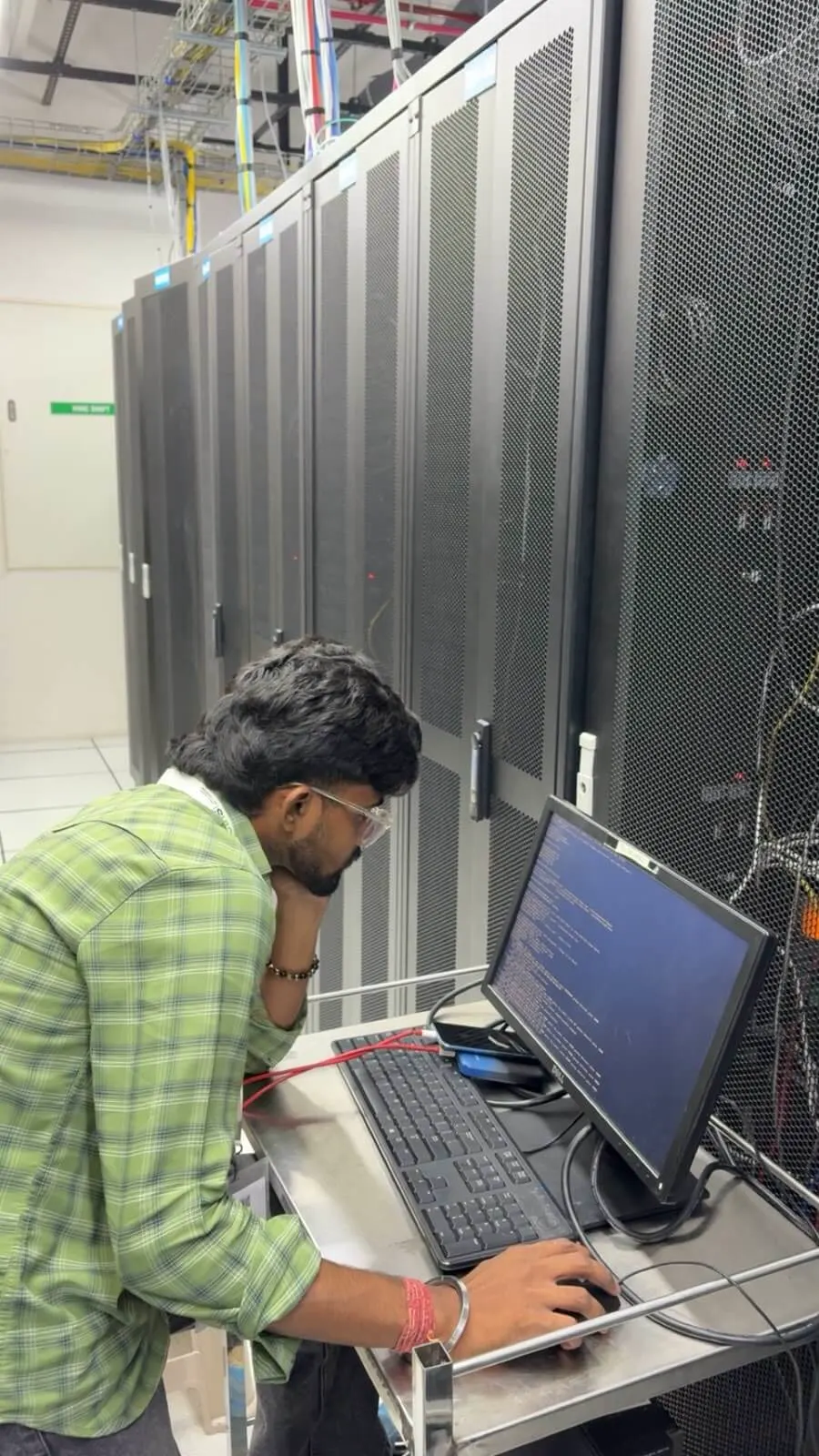
Photo eWebGuru engineer configuring a dedicated server from a console beside the rack

2. Operating system build

The OS is installed to the agreed disk layout, hardened against our baseline, and the control panel and application stack configured. The server is handed over with monitoring attached and backups already running.

Console work at the rack, Ironmountain, Noida · August 2026
Video 0:05

3. Inside the facility

Your server sits in a named facility with redundant power and cooling, in a hall we hold space in rather than resell. We tell you which building before you sign, and it is not relocated without your written agreement.

Colocation hall, Ironmountain, Noida · August 2026
Video 0:07

4. Hands at the rack

Hardware faults are diagnosed and replaced by our own engineers on site. Monitoring raises drive, memory and PSU alerts from IPMI and SMART data, and we send a written summary of what was found and changed.

Engineer on site at Ironmountain, Noida · August 2026

More from our datacentres

Short clips from the same facilities and team.

0:11
Server provisioning · Ironmountain, Noida
0:04
Engineering work on site · Ironmountain, Noida
0:03
Our rack · Ironmountain, Noida
0:07
Our team on site · Ironmountain, Noida

Tell Us About Your Workload

Managed dedicated servers are quoted per configuration, because the amount of management work depends on the application stack rather than the hardware. Billing in INR or USD, GST invoiced.

Thank you — we have received your requirement

Your enquiry has been logged with our pre-sales team and a support ticket has been created, so you have a record you can refer to at any time.

Your reference:
  • 1 We review the workload. If anything in the requirement needs clarification, we will ask before preparing the quotation.
  • 2 You receive a written quotation covering configuration, facility, network port, support scope and contract terms.
  • 3 You hear from a server engineer. If a managed dedicated server is not the right fit for your workload, we will say so and suggest an alternative.

To discuss it sooner, call 880-033-4921 or use live chat, quoting the reference above.

A support ticket is created automatically so your enquiry is tracked, and a server engineer will respond.

Where Your Server Is Located

We deploy managed dedicated servers into CtrlS, Iron Mountain and Yotta facilities across Delhi NCR, Mumbai and Pune. You are told which facility your server is in before you sign, and it is not relocated without your written agreement.

The servers connect to our own network on AS133643. Because we operate the ASN ourselves rather than reselling another provider's IP space, we can support customers who need to announce their own address space over BGP.

  • FacilitiesCtrlS · Iron Mountain · Yotta
  • LocationsDelhi NCR, Mumbai, Pune
  • NetworkAS133643 (own ASN)
  • IP addressingIPv4 and IPv6 on every server
  • Customer IP spaceSupported via BGP; justified through APNIC / IRINN
  • Remote handsYes — hardware handled by our team
  • Out-of-band accessIPMI / iDRAC / iLO on management VLAN
  • Data residencyIndia; INR billing, GST invoicing
  • NOC monitoring24×7, in-house
  • Information reviewedAugust 2026
Request a Quotation
Our Rack
Our Rack eWebGuru server rack in an Indian datacentre used for managed dedicated server hosting

Managed Dedicated Compared With Other Options

Including the situations where another type of hosting is the better answer.

Comparison of managed dedicated, unmanaged dedicated, managed VPS and public cloud
  Managed Dedicated Unmanaged Dedicated Managed VPS Public Cloud
Server administrationeWebGuruCustomereWebGuruCustomer
Dedicated physical hardwareYesYesNoNo
Need to manage the OS yourselfNoYesNoYes
Scaling within minutesNoNoLimitedYes
Cost predictabilityHighHighHighVariable
Data residency controlNamed facilityNamed facilityNamed facilityRegion, not facility
Best suited toStable, resource-intensive workloadsTeams with server expertiseGrowing workloadsHighly variable workloads

Standard Support Response Targets

Severity is assigned by the impact on your service, not by how the ticket is worded — our NOC can raise a critical ticket without you asking.

Standard support response targets by incident severity
Severity Target First Response What Qualifies
CriticalWithin 15 minutesServer down, data corruption, active compromise
HighWithin 1 hourService degraded, backup failure, predicted hardware failure
NormalWithin 4 hoursConfiguration changes, software installation, tuning requests
LowWithin 24 hoursAdvisory questions, documentation, architecture consultation

Please read these as operational targets, not guarantees. They describe how our support desk prioritises work under normal conditions. Resolution time depends on the nature of the fault, hardware availability and, in some cases, third-party vendors, so we do not publish a single resolution figure that would apply to every incident. Contractual service levels, uptime commitments and any associated service-credit schedule are agreed per configuration and set out in your service agreement — ask for them during the quotation stage.

Security patching: our target of 24 to 48 hours for critical vulnerabilities is subject to vendor patch availability, compatibility testing against your applications, and any maintenance window required. Where a patch cannot be applied within that period, we record the reason and the planned date on your account.

Provisioning: a new server is normally ready within 2 to 5 business days. This depends on hardware availability, the configuration requested and the facility selected. We confirm an expected date in the quotation rather than at the point of order.

Compliance and Regulated Workloads

We can configure and operate dedicated servers using controls commonly required for regulated environments, including access controls, logging, encryption, change management and retention policies.

Infrastructure configuration alone does not make an application PCI DSS, HIPAA or SOC 2 compliant. eWebGuru does not claim that hosting a server with us automatically provides certification or compliance for your business.

If you have a specific compliance requirement, tell us before deployment. We can identify which infrastructure controls we are able to provide and which controls remain your responsibility, and set that out in writing as part of the quotation.

Frequently Asked Questions

What is managed dedicated hosting?
A managed dedicated server gives you an entire physical server for your workload, while the provider handles the operating system and day-to-day server administration: setup, security hardening, updates, monitoring, backups and hardware-related issues.
Do I get root or Administrator access?
Yes. Linux servers are provided with root SSH access and Windows servers with Administrator RDP access. Our team also holds access in order to patch and monitor the server. Where a customer change conflicts with our configuration management, support for that specific subsystem may be limited, so we ask that production changes are raised as a ticket.
What exactly is included in server management?
Operating system installation and hardening, security updates, firewall and access control, control panel maintenance, web and database server configuration, backup configuration and restores, monitoring, mail server configuration and hardware fault handling. Application development, custom deployment pipelines and clustered architectures are quoted separately. The full responsibility matrix is published on this page.
How quickly are security vulnerabilities patched?
Our internal target for critical vulnerabilities is to apply the vendor patch within 24 to 48 hours of release. Actual timing depends on patch availability, compatibility with the applications running on the server, and any maintenance window required. These are operational targets rather than contractual guarantees unless stated in your agreement.
What happens if the server hardware fails?
Our monitoring raises hardware alerts from IPMI and SMART data, including predictive drive failure warnings. Our team handles diagnosis and component replacement at the rack, and the RAID array is rebuilt or failed over. We provide a written summary of what occurred and what was changed.
Can you migrate my existing server?
Yes. Standard cPanel, Plesk and DirectAdmin migrations are included in onboarding. We stage the data, run a parallel sync so both servers hold the same content, and change DNS at a time you choose. Migrations involving custom applications or unusual architectures are assessed before we commit to a plan.
Where are the servers located?
In CtrlS, Iron Mountain and Yotta facilities across Delhi NCR, Mumbai and Pune, connected to our own network on AS133643. You are told which facility your server is in before you sign, and it is not relocated without your written agreement. Customers who hold their own IP space can announce it over BGP; Indian address space is justified through APNIC or IRINN.
How much does a managed dedicated server cost?
Managed dedicated servers are quoted per configuration after a workload review, because the amount of management work depends on the application stack rather than the hardware. Submit the requirement form for a written quotation covering configuration, facility, network port and support scope. Billing in INR or USD, GST invoiced.
AA

Ashok Arora

Founder, eWebGuru

Ashok Arora founded eWebGuru in 2007 and has worked in web hosting and server infrastructure since. He works with dedicated servers, VPS infrastructure, Linux and Windows hosting and Indian datacentre operations, and oversees eWebGuru's hosting services.

Written and reviewed by: Ashok Arora, Founder, eWebGuru
Last reviewed: August 2026
Scope of review: server configurations, support scope and responsibility matrix, datacentre and network information, security and backup practices, and support response targets.

Need a Managed Dedicated Server?

Tell us about your workload, current infrastructure and required configuration. Our server team will recommend a suitable configuration and provide a written quotation.

Request a Quotation   Talk to a Server Engineer

880-033-4921 · Live chat 24×7 · [email protected]

Latest from eWebGuru Blog

Guides and updates on dedicated server hosting.